PUBLICATION: Analysis
The Regional Dimension of a Montenegro’s Local Feud
The city of Kotor, one of Montenegro’s most famous tourist destinations known for its rich history and medieval fortresses, has acquired a different kind of reputation in recent years: it has become known as the birthplace of two criminal clans which are involved in a bloody war to extinction.
The groups are symbolically named after two small parts of Kotor – Škaljari and Kavač, two settlements that are three and a half kilometres apart and separated by the Vrmac mountain.
The clans are not the first — and certainly not the last — criminal groups who originated from this small Balkan country. They had many predecessors, but up until now, none have been entangled in an intense and prolonged mutual conflict as the Škaljari and Kavači clans have.
Before the war, these two clans used to make up one group – named Škaljari – whose emergence and strengthening happened after the collapse of athen-leading international cocaine-smuggling group in the Balkans, led by narco-boss Darko Šarić. Šarić added a new feature to the illegal activity he was engaged in: his group was the first to smuggle over a ton of cocaine in a single shipment. Unlike those who followed his fall, Šarić’s approach to drug trafficking was more business-like, as his focus was primarily to make money and move it into legal, financial flows. By breaking up his group in 2009, the police and anti-narco-trafficking agencies created a vacuum that was quickly filled by criminals, as it turns out, of a different kind – the ones eager to prove themselves and earn huge amounts of money, so much so that they caused an unprecedented and brutal bloodshed. Šarić surrendered to the police in Serbia in 2014 and was convicted to 15 years of prison, where he remains today, though his verdict isn’t final yet.
The Škaljari clan, which was for some time divided into two groups, quarrelled fiercely and a seemingly minor skirmish led to a clash that would claim at least 50 lives and make Montenegro the place of origin of a brutal mafia war that would spread across the region and to Western European countries.
The conflict broke out due to the disappearance of about 200 kilograms of cocaine in 2014 in Valencia, Spain. Although this amount of cocaine wasn’t much for a group that smuggled tones of it, the clash exploded and created a violent rift. The war upended the region’s underworld and pulled in other Serbian and Montenegrin crime groups who decided to join one of the two rival clans. Furthermore, some police members and politicians also took sides.
The first victim was killed in the Serbian capital, Belgrade, in February 2015. Throughout the years, the number of murders related to the clan war kept rising and ultimately culminated in 2018 – when at least 13 people were killed in Serbia and Montenegro.
It didn’t take long for the crime war to spread to European countries. Since Serbia and Montenegro were hotspots, criminals tried to save their lives by hiding elsewhere in Europe. Not everyone, however, succeeded. Some of them were found by killers and murdered in Austria, Netherlands, Spain, Germany, and Greece. This added a new dimension to the feud: it became international, and different governments and police and prosecution units started their investigations.
As time went on, the warring parties became more and more cruel. Cities in Serbia and Montenegro often resounded with car bomb explosions, and armed attackers stormed cafés and restaurants in search of their opponents and victims. They did not care much about possible collateral victims and, on several occasions, individuals who found themselves in the wrong place at the wrong time were killed. In the meantime, the murders of the rival gang members, as it later turned out, reached new levels of brutality – they would torture them to death, butcher their bodies and dissolve them in acid. In Serbia, at least 15 young men went missing in just two years and what happened to most of them is still unknown. The fact that most of the assassinations as well as kidnappings occurred in public places and during the day — or early evening hours — spotlights that citizens’ security had reached extremely low levels.
The Serbian government tried in vain to shield the public from this harsh reality – first by finding creative and deceitful ways of interpreting murder statistics, then by insisting that the crime had been “imported” to Serbia from abroad. This tactic served an additional purpose: it was supposed to help politicians present the government as the true fighter against organized crime and distance themselves from warring crime groups.
But the situation on the ground was quite different.
Instead of targeting organized crime, it looks like the Serbian government took a side in the mafia war. The police focused on the Škaljari clan and mostly arrested its members and allies; officials have repeatedly made statements about the dangers posed by the Škaljari clan and used pro-government media to upgrade stories about this criminal group. On the other hand, both officials and the media under their control rarely mentioned Kavač clan members and their involvement in crimes. Furthermore, KRIK discovered that some individuals from the police and the political class have strong ties with this clan’s branch in Serbia – a group led by Veljko Belivuk – and that they even go up to President Aleksandar Vučić.
The group members were close to Nenad Vučković, a high-ranking police officer who was their main link to Dijana Hrkalović, State Secretary of the Ministry of Police. Vučković was seen with group leaders at football matches in Belgrade and was Hrkalović’s partner. Also, after one of the prominent people of the Kavač clan, Davorin Baltić, was killed in 2018, it was revealed that he was the godfather of police officer Marija Nikolić.
Another important link was Novak Nedić, who served as Vučić’s Secretary Generalwhen he was Prime Minister: during that time, he and Belivuk practiced their shooting skills at a military-owned shooting range in Pančevo. The Serbian Military Union even filed a criminal complaint against them, but the prosecutor closed the investigation after some of the evidence mysteriously disappeared. KRIK also discovered that members of Belivuk’s gang provided security for the 2017 inauguration of President Vučić, during which they assaulted protesters and journalists.
Some group members were close to Vučić’s own son, Danilo. He was often seen together with Aleksandar Vidojević Aca Rošavi, who was identified as a Kavač gang member by Serbian police. Photos show them together watching Serbia’s match at the 2018 World Cup in Russia as well as on the celebration of the declaration of Republika Srpska in Banja Luka. They were also photographed inside a night bar and watching a football match in a café in Belgrade’s city centre.
With this kind of support in Serbia and with more and more victims on Škaljari side, it looked like the Kavač clan was winning the war. This impression intensified in January of last year when two key men of the Škaljari criminal clan were killed while having dinner at a restaurant in Athens, Greece. An unknown and armed assailant came into the restaurant and shot them in front of their families. This double murder meant something more: it was an act that would beheaded this criminal group.
However, it turned out that it was too early for Kavačs to celebrate. Despite good, long-term cooperation with people from state structures, they faced huge problems. The situation changed and the Serbian government declared a war against the mafia. This wasn’t the first time that war was declared, but unlike previous times, something happened – top members of Kavač clan were arrested in Montenegro, Serbia, Slovenia, and Bosnia-Herzegovina. Its leader, Radoje Zvicer, is on the run and on the Interpol’s wanted list. Veljko Belivuk, leader of the Serbian branch of the clan and his close associates have been arrested and indicted for the five brutal murders of his rivals – men who were close to the Škaljari clan. Vidojević hasn’t been arrested and wasn’t under investigation in this case.
It is still unclear why the Serbian government decided to deal with this crime group at this specific moment since the group had been protected for so long. Explanations for how the group created its ties to state structures and who is responsible for them will obviously not be given by the Serbian unit prosecuting organized crime. The prosecution didn’t investigate the period when the group was getting stronger nor the connections with the government. Unlike their criminal associates, key people from the police and government are still protected.
By arresting leaders and members of the Kavač and Škaljari clans, the vacuum is once again being created. A new organized crime group will rise again and fill it.
Tags: Kavač, Kotor, montenegro, Škaljari

PDF PREVIEW
RELATED

Date: 27.05.2026.
Author: Anđela Savić |
Civil society organisations, journalists, and human rights defenders across the Western Balkans and European Union (EU) are operating in a digital environment defined by raising threats and inadequate protection. This analysis presents findings from a needs assessment survey conducted within the “Defending Digital Freedoms: Strengthening Civil Society Resilience against Digital Repression in Europe” project, gathering 239 responses from 11 countries (six Western Balkan and five EU member states).
Date: 01.02.2026.
Author: Belgrade Centre for Security Policy
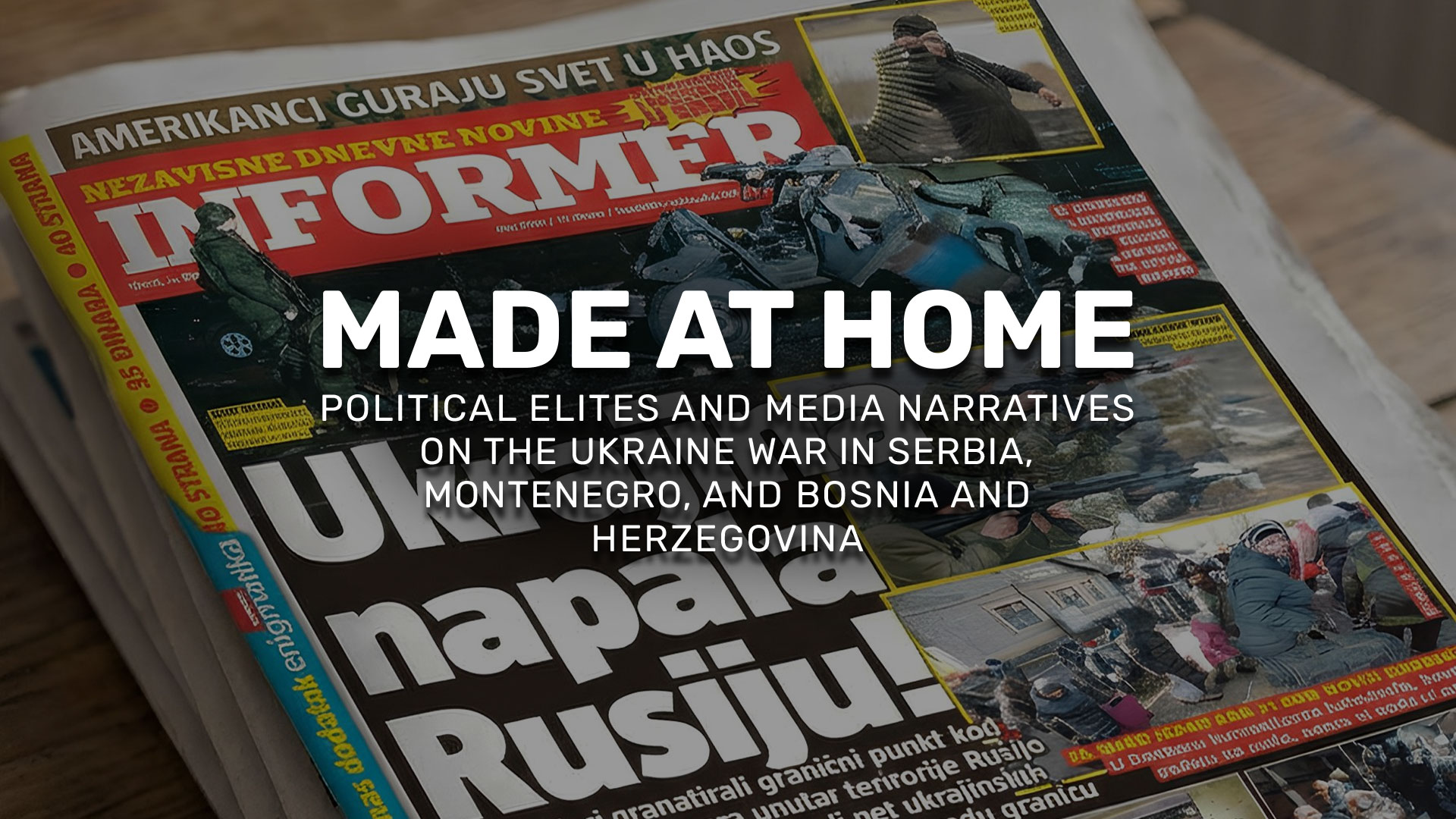
The war in Ukraine has reverberated across the Western Balkans in ways that reflect the region’s own political dynamics more than the influence of any external actor, including Russia. In Serbia, Montenegro, and Bosnia and Herzegovina, media coverage and public narratives surrounding the conflict have been shaped primarily by domestic political realities, local media structures, and long-standing identity divides.

Date: 26.01.2026.
Author: Belgrade Centre for Security Policy
The point of departure for this analysis was the idea that spyware, by its nature, is an indiscriminate, comprehensive and covert surveillance tool, structurally incompatible with the principles of necessity, proportionality and targeted data processing.