PUBLICATION: Study
Extremism From Above: Serbia’s Ruling Party as the Principal Anti-Establishment Extremist Actor
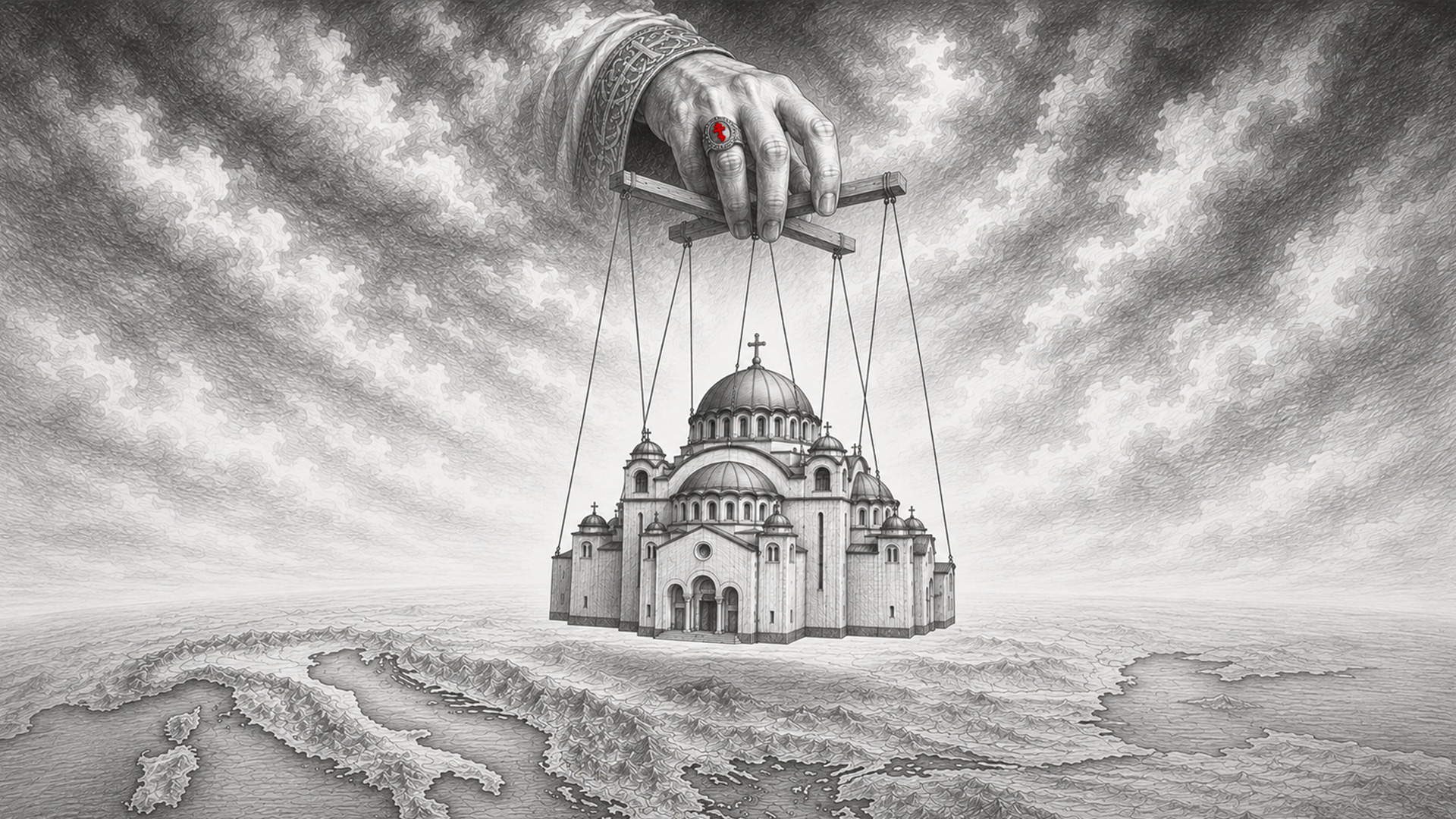
In the past decade, European countries have witnessed a rise in anti-establishment extremism (AEE), which challenges the modern democratic order and offers authoritarian modes of governance as a “solution” to consecutive, overlapping crises.
Unlike most European states – where AEE is primarily carried by marginal movements, fringe actors, or parties outside government, or at most minor coalition partners – in Serbia the main bearer of AEE is the ruling Serbian Progressive Party (SNS), which has held power continuously for thirteen years. Serbian Progressive Party rose to power on rhetoric centred on democracy, the rule of law, and EU integration, principles also formalised in its Statute, but quickly became the key anti-system actor dismantling Serbia’s institutions and constitutional order from within and from above.
Although it still publicly advocates democratic principles and the rule of law, the ruling party in practice displays all core elements of AEE: (1) The delegitimisation and marginalisation of state institutions and the constitutional system of Serbia, along with the creation of a parallel, extra-institutional system of governing the state and society (the so-called ‘silent coup’), which undermines the rule of law and the separation of powers as defined by the Constitution; (2) a nationalist-authoritarian ideological framework – the “Serbian World” – which homogenises society, delegitimises pluralism, and promotes political unity of the Serbian people under the leadership of Serbia’s President Aleksandar Vučić; (3) the legitimisation of hostile and violent acts against dissenters through conspiracy theories about “colour revolutions,” “foreign mercenaries,” “coup attempts,” “diversion,” and “terrorism”; (4) the paramilitary organisation of “loyalists,” formations with features of secret and paramilitary groups, composed of criminals, hooligans, and extremists loyal to the President; (5) hate speech and systematic violence perpetrated by the ruling party and its officials against dissenters; (6) the trivialisation of violence and the absolution of perpetrators through presidential pardons. The text provides an analytical overview of these patterns and their consequences for Serbia’s democratic order.
DETAILS
AUTHORS

SHARE
PDF PREVIEW
RELATED
Datum: 06.08.2026.
Autor: Beogradski centar za bezbednosnu politiku
In the past decade, European countries have witnessed a rise in anti-establishment extremism (AEE), which challenges the modern democratic order and offers authoritarian modes of governance as a “solution” to consecutive, overlapping crises.

Datum: 21.07.2026.
Autor: Beogradski centar za bezbednosnu politiku
In November 2025, the Belgrade Centre for Security Policy published the policy brief Political and Institutional Crisis in Serbia: Possible Scenarios. The brief outlined four scenarios and their corresponding outcomes.
New Extremist Trends in Serbia: Anti-System Extremism, Extremist Telegram Channels and Eco-Extremism
Datum: 30.06.2026.
Autor: Beogradski centar za bezbednosnu politiku
This report analyses recent and so far insufficiently explored forms of extremism in Serbia, with a particular focus on anti-system extremism, the role of the Telegram digital platform and the instrumentalisation of environmental issues.