Unpacking the EU’s integrated approach to external conflicts and crises
The final EUNPACK conference will bring together researchers with policymakers, civil society representatives and other practitioners, drawn from universities, think tanks, the EU institutions, and diplomatic missions to discuss how EU crisis responses function on the ground. The conference will take place on 18-19 March 2019 at CEPS (1 Place ...
The final EUNPACK conference will bring together researchers with policymakers, civil society representatives and other practitioners, drawn from universities, think tanks, the EU institutions, and diplomatic missions to discuss how EU crisis responses function on the ground. The conference will take place on 18-19 March 2019 at CEPS (1 Place du Congrès, 1000 Brussels).
The conference will provide an opportunity to look back at three years of research and fieldwork and to consider the policy implications of its findings.
How has EU crisis response been shaped by the two gaps the projects analysed – between intentions and implementation and between implementation and local reception/perceptions? How did these gaps determine the EU’s ability to contribute more effectively to problem-solving on the ground? To answer these questions, EUNPACK combines bottom-up perspectives with an institutional approach in order to deepen our understanding of how EU crisis responses function and are received on the ground in crisis areas. This entails exploring local agencies and perceptions in target countries without losing sight of the EU’s institutions, their expectations and ambitions. It also entails examining the whole crisis cycle.
EUNPACK is realized by a consortium of European universities, think-tanks and civil society organizations, with BCSP as one of the members. The objective of BCSP’s engagement is to contribute to exploring micro-level practices of EU foreign policy in Serbia and Kosovo. The key assumption is that the EU’s engagement in the candidate countries relies on various forms of external governance. This implies practices that are different from traditional diplomatic relations characterizing foreign policy of states. The latter is based on the principle of non-interference by diplomats of a sending state in the domestic affairs of the host country (Vienna Convention 1961, Art 44). External governance, by contrast, is characterized by deep interference in domestic affairs including various practices and techniques applied to monitor and oversee implementation of governance reforms. Moreover, working with societies of the EU’s candidate countries implies not only working with governmental structures, but – as these societies are in processes of democratic transition and stabilization of democratic institutions – it also implies engagement with various segments of civil society, regional and local authorities. This involves a specific set of micro-level practices, which enable EU representatives to work effectively in supporting reform processes in target countries.
Speakers:
- Morten Bøas, Research Professor, NUPI
- Francesco Strazzari, Sant’Anna University, Pisa
- Ruben-Erik Diaz-Plaja, Policy Planning Unit, Office of the Secretary General, NATO
- René Van Nes, Deputy Head of Division, EEAS
- Jozef Batora, Professor, Comenius University
- Sonja Stojanovic Gajic, Director, Belgrade Centre for Security Policy
- Steven Blockmans, Senior Research Fellow & Head of EU Foreign Policy, CEPS
Tags: ..., approach, civil, conflicts, countries, crises, crisis, engagement, eu&rsquo, european, external, foreign, governance, implementation, implies, integrated, policy, practices, research, unpacking
DETAILS
DATE:
TIME:
LOCATION: Belgrade Center for Security Policy
CONTACT: dragana.belanovic@bezbednost.org
SHARE
RELATED
Date: 10.02.2026.
Author: Belgrade Centre for Security Policy
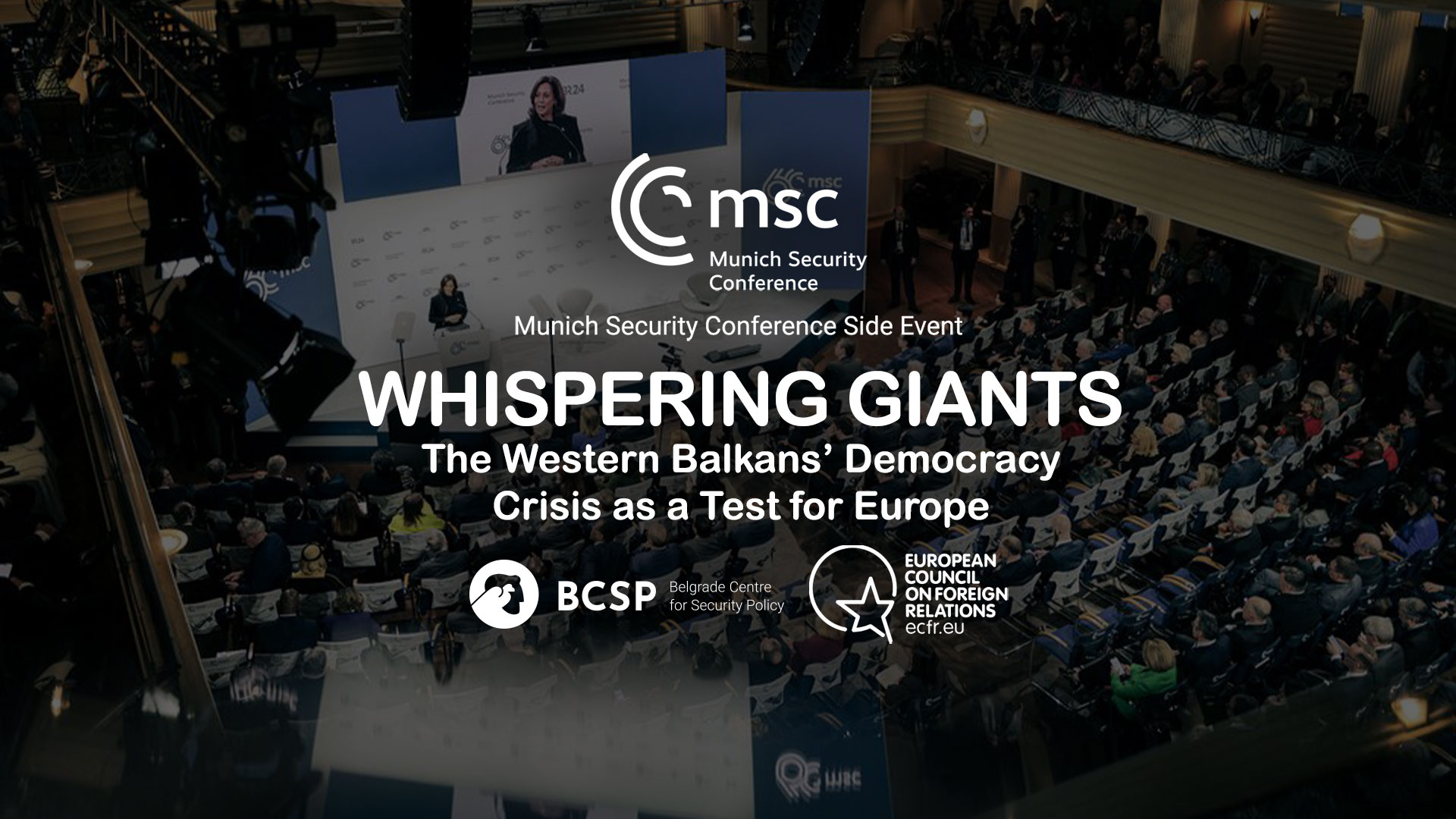
The Belgrade Centre for Security Policy (BCSP) and the European Council on Foreign Relations (ECFR) are co-hosting a side event "Whispering Giants: The Western Balkans’ Democracy Crisis as a Test for Europe," at this year’s Munich Security Conference on 13 February.

Date: 18.02.2025.
Author: Belgrade Centre for Security Policy
On 20 February 2025. at Envoy Conference, Belgrade Centre for Security Policy will present the latest research “Non-Malign Influence - What Does the Russian Community in Serbia Think and Do”.

Date: 10.02.2025.
Author: Belgrade Centre for Security Policy
The Belgrade Centre for Security Policy (BCSP) and the European Council on Foreign Relations (ECFR) are co-hosting a side event "Unarmed in the Unseen War: How to Counter Hybrid Challenges in the Western Balkans and Europe," at this year’s Munich Security Conference on 14 February.