FOREIGN INFLUENCE
Which foreign actors are trying to exert negative influence over Serbia, how and why? Is Serbia encouraging or deterring such activity and why? How can negative influence be curtailed?
RELATED

Date: 24.03.2026.
Author: Dr Srđan Cvijić |
This publication assesses how six external actors - Russia, China, Türkiye, the United Arab Emirates (UAE), Israel, and Azerbaijan - engage with the Western Balkans (WB) and how such engagement affects the European Union (EU) enlargement process.

Date: 09.02.2026.
Author: Maja Bjeloš |
The concept of the “colour revolution” has shifted from describing democratic uprisings in post-socialist states to serving as a powerful tool of authoritarian control. In Serbia, the ruling elite—drawing heavily on the Russian strategic playbook—has reframed the term as a symbol of foreign subversion aimed at overthrowing the government and destabilising the country. Since 2012, this narrative has been systematically used to delegitimise dissent, protests, and civic mobilisation.
Date: 01.02.2026.
Author: Belgrade Centre for Security Policy
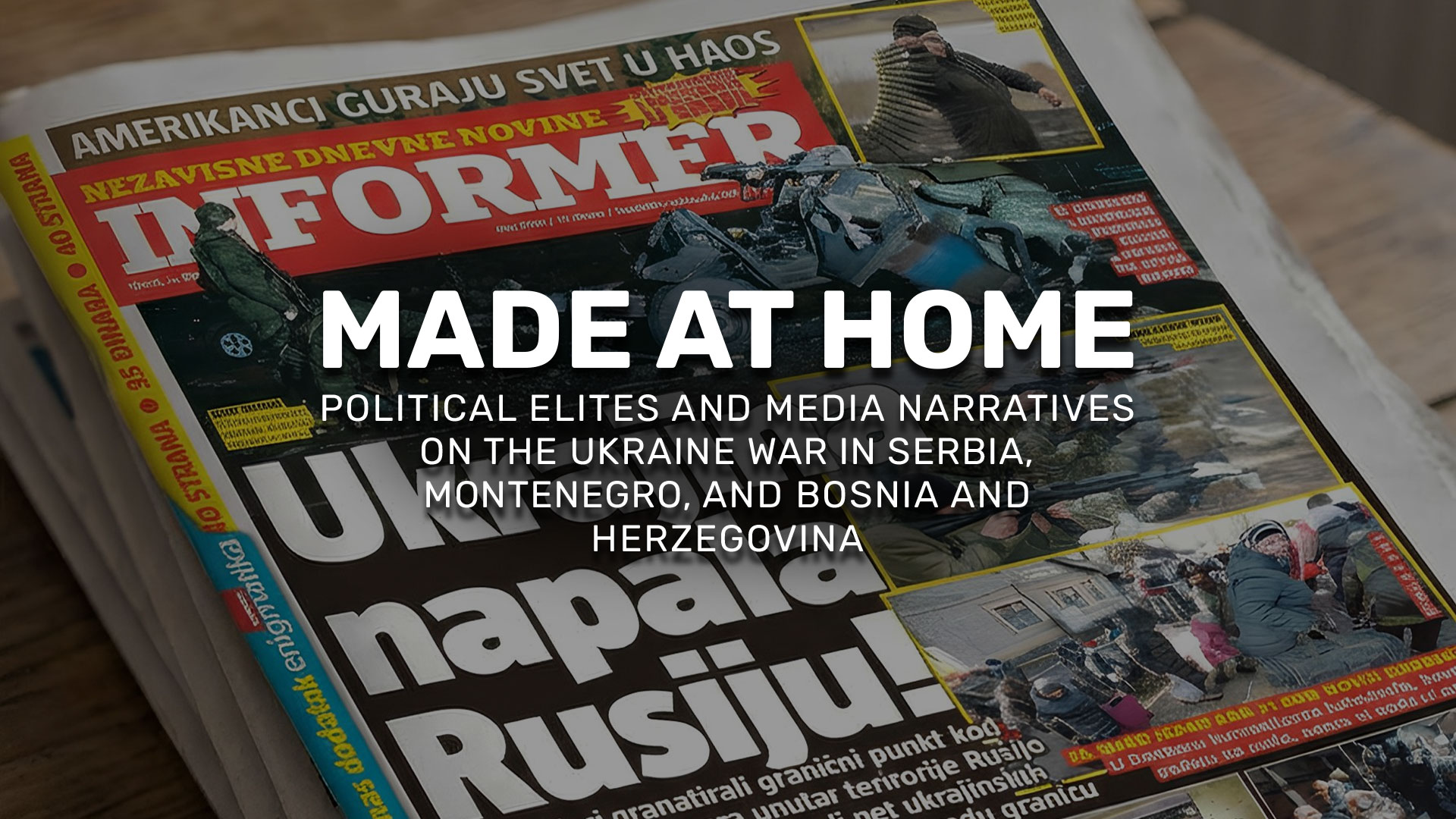
The war in Ukraine has reverberated across the Western Balkans in ways that reflect the region’s own political dynamics more than the influence of any external actor, including Russia. In Serbia, Montenegro, and Bosnia and Herzegovina, media coverage and public narratives surrounding the conflict have been shaped primarily by domestic political realities, local media structures, and long-standing identity divides.

Date: 25.12.2024.
Author: Belgrade Centre for Security Policy
The international system is undergoing profound changes and one of the main ones is the growth of China’s global influence, which is gradually turning into a source of influence comparable to the United States. This process is accompanied by the growth of China’s political and economic presence in different regions of the world. Europe is no exception, but this process varies greatly in different countries, with some countries only cautiously developing ties with China while others seek to expand them as much as possible.

Date: 16.10.2023.
Author: Srđan Hercigonja | Vuk Vuksanović |
Turkey’s more assertive posture towards the Balkans is neglected compared to the commentariat that deals with Russia and China. To fill this policy gap, the research team of the Belgrade Centre for Security Policy (BCSP) has conducted research based on the analysis of secondary source material and, even more importantly, on fieldwork interviews that involved 16 sources, academics and think tank researchers based in Istanbul and Ankara.

Date: 20.02.2023.
Author: Belgrade Centre for Security Policy
The war against Ukraine and Ukraine's application for EU membership changed the way the EU looks at the Western Balkans and enlargement process, it is concluded during the discussion at the Munich Security Conference, co-organized by the Belgrade Centre for Security Policy (BCSP) and European Council on Foreign Relations (ECFR).

Date: 14.12.2022.
Author: Vuk Vuksanović | Dr Srđan Cvijić | Maksim Samorukov |
Public opinion in Serbia and Russian soft power are some of the topics of the BCSP analysis written by BCSP Senior Researcher Vuk Vuksanović, President of the International Advisory Committee Srđan Cvijić and BCSP Visiting Fellow Maksim Samorukov.

Date: 30.06.2022.
Author: Vuk Vuksanović | Maja Bjeloš |
This report examines the Chinese presence in Serbia through a human security lens, in terms of how it impacts the quality of life and the security of local communities.

Date: 17.01.2022.
Author: Vuk Vuksanović |
What narratives are used to describe the cooperation of the Serbian government with illiberal forces such as Russia and China, and how those narratives are related to the capture of the state in Serbia, read in the text written by BCSP senior researcher Vuk Vuksanović.