PUBLICATION: Analysis
Public Perception of Serbia’s Foreign Policy
The latest Belgrade Centre for Security Policy (BCSP) working study summarizes the key findings of a survey on relations towards major powers and their influence on Serbia and Serbia’s foreign policy. The research was conducted from 26 December 2016 until 14 January 2017 on reprezentative sample of 1,403 adult citizens of Serbia (excluding Kosovo).
According to the most recent survey conducted by a questionnaire designed by BCSP the majority of citizens of Serbia is still in favor of EU membership, against NATO membership, and satisfied with the existing level of cooperation with Russia. Perception of EU has recently deteriorated; it remains authority only in the domain of democracy and rule of law, and membership is expected to further economic benefits and international standing. The majority demands a better definition of the Serbia’s policy of neutrality.
Complete results can be read here.
The majority views Russia as a political and military power, while USA as an economic and technological giant. EU & Germany are successful in democracy, human rights, and rule of law, and have credible investors. Citizens believe that China is a successful economic and political power.
The majority of respondents regarded influence of Germany, China and Russia as positive, while the influence of EU and USA is seen as mostly negative. Citizens do not expect a change in American foreign policy toward Serbia. Membership in the EU would attract foreign investment and increase employment, while alliance with Russia would enhance security.
One-third desires Serbia’s integration into a Russia-led Eurasian Union, one-fifth is against, and the majority has no opinion. The majority has no opinion on the Crimea issue and believes that Serbia should remain neutral regarding the Ukraine conflict.
There is more negative than positive sentiments regarding a potential NATO membership. Every eleventh respondent in favor of NATO membership, one-fifth expects membership to have positive influence on security and FDI influx. One-third is in favor of cooperation through the Partnership for Peace, among them are those who prefer more intensive cooperation.
If recognition of Kosovo were a requirement the majority would give up on EU accession. The length of accession affects the public perception so that the majority believes Serbia will never become EU member. Although the majority is indifferent regarding a EU disintegration, there are more positive than negative associations and especially regarding peace, democracy, human rights and economic benefits.
The majority supports the policy of neutrality, and among the supporters the most numerous are those who demand better specification of the policy of neutrality. Among those in favor of “choosing sides”, the majority are the supporters of Dveri, DSS, SRS, DJB and LDP.
There is slightly more of those supporting involvement of Serbia beyond its borders in resolving security issues, and similar in relation to the conflict in Syria. The costs of engagement are key criteria for selecting destinations of engagement. Most support for the existing commitment under the UN flag, and in cooperation with Russia and the EU.
This study presents the second part of research findings. The main conclusions on security of Serbia and the dialogue with Pristina were published in February, while another presentation on trust in institutions will be delivered in forthcoming period.
The publication is a part of the project entitled “Renewed and revised co-operation between the BCSP, regional partners and the Norwegian Institute of International Affairs”, funded by the Norwegian Ministry of Foreign Affairs.
DETAILS
AUTHORS

SHARE
PDF PREVIEW
RELATED

Date: 09.02.2026.
Author: Maja Bjeloš |
The concept of the “colour revolution” has shifted from describing democratic uprisings in post-socialist states to serving as a powerful tool of authoritarian control. In Serbia, the ruling elite—drawing heavily on the Russian strategic playbook—has reframed the term as a symbol of foreign subversion aimed at overthrowing the government and destabilising the country. Since 2012, this narrative has been systematically used to delegitimise dissent, protests, and civic mobilisation.
Date: 01.02.2026.
Author: Belgrade Centre for Security Policy
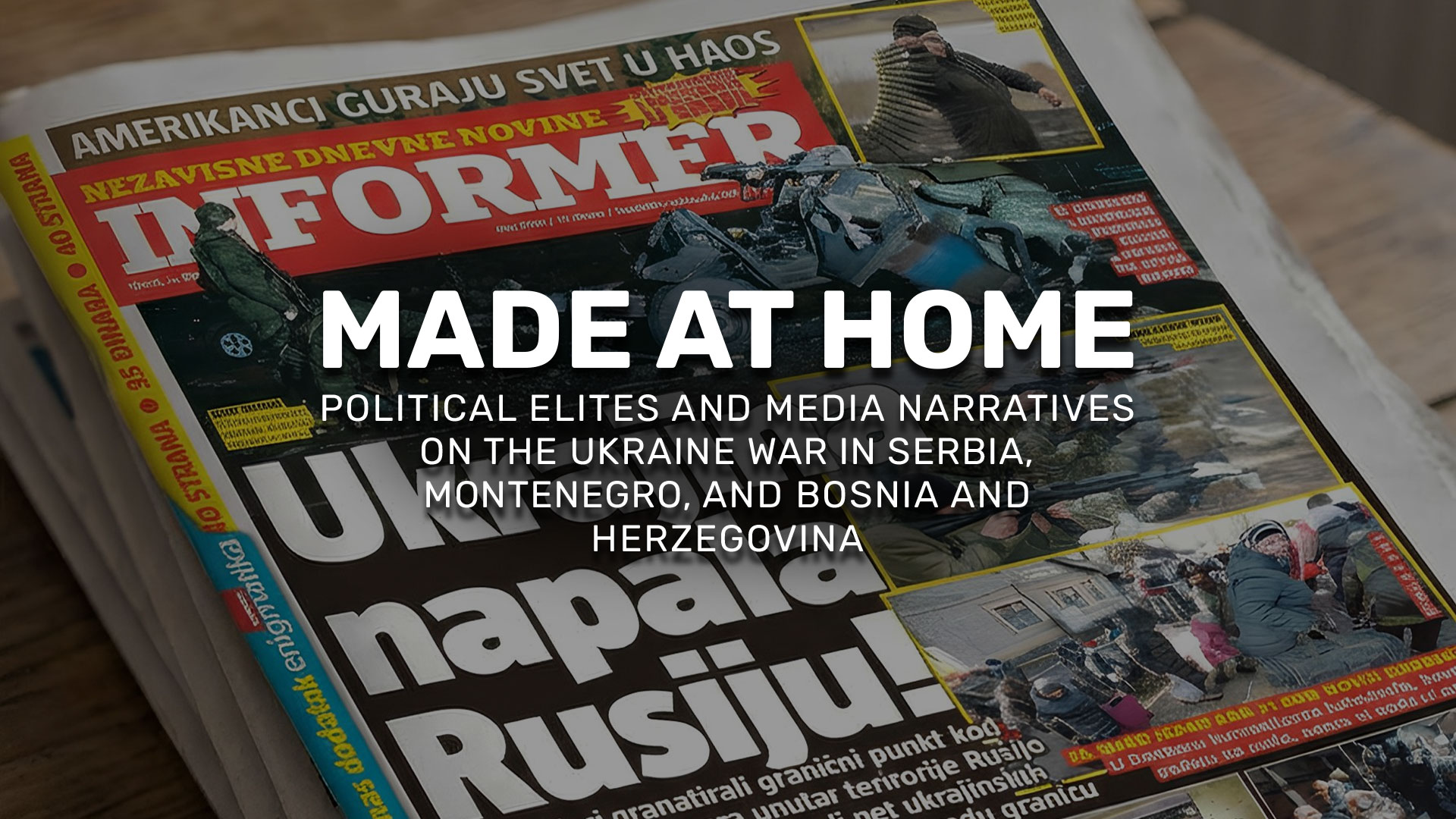
The war in Ukraine has reverberated across the Western Balkans in ways that reflect the region’s own political dynamics more than the influence of any external actor, including Russia. In Serbia, Montenegro, and Bosnia and Herzegovina, media coverage and public narratives surrounding the conflict have been shaped primarily by domestic political realities, local media structures, and long-standing identity divides.
Date: 22.10.2025.
Author: Jelena Pejić Nikić |
This policy paper examines Western Balkan stakeholders' perspectives on what is needed for meaningful enlargement and the EU reforms they consider essential for an effective expanded Union. Field research in spring and summer 2024 included 16 high-level interviews with representatives from all six countries of the region.