PUBLICATION: Book
The Violent Dissolution of Yugoslavia – Causes, Dynamics and Effects
Collection of papers GORAGRAF and the Centre for Civil-Military Relations, Belgrade, 2004
“Without public, open and expert debate about recent war legacy, the complete maintaining of security and cooperation in the area of former Yugoslavia will not be possible”, wrote Miroslav Hadžić in introductiony remarks of the book “National dissolution of Yugoslavia – causes, dynamics and effects”, which was published by the Centre for Civil-Military Relations, with support of the OSCE Mission in Serbia and Montenegro. The papers of the participants at the international scientific conference, held at the Faculty of Political Science in Belgrade, on March 5-6, 2004, are collected in this book, named the same as the conference. This conference was organized in desire to “contribute to the analysis of the causes, origins and mechanisms of the (self) perpetuation of wars in the former Yugoslavia, as well as to support and encourage a professional dialogue”. Professor Dr. Miroslav Hadžić, who redacted and edited the papers, pointed out “that it was expected for the participants of the conference to offer an innovative and modern theoretical and methodological framework for further research into the socio-political and military nature of the Yugoslav wars”.
The first chapter of the book named General causes and dynamics of local and internal wars contains the papers of Ditrih Jung and Haakan Wiberg, while the chapter Differentia specifica of wars in Yugoslavia contains the papers of Alpar Lošonc, Ivan Vejvoda, Tonči Kuzmanić and Carl-Urlik Schierup. Latinka Perović, Milan Vukomanović, Miroslav Hadžić, Vlasta Jalušič and Mihajlo Basara presented their own rewieving of the Yugoslavia’s violent dissolution in the chapter named Caused and dynamics of wars in Yugoslavia, while the papers of Milan Podunavac, Mojmir Križan, Vojin Dimitrijević, Jasmina Glišić and Kruno Kardova were presented in the last chapter named Prospect for normalizations and achievement of security.
Tags: ..., belgrade, causes, centre, chapter, civil, collection, conference, dissolution, dynamics, effects, goragraf, military, named, papers, relations, violent, yugoslavia

PDF PREVIEW
RELATED

Date: 21.07.2026.
Author: Dr Srđan Cvijić | Igor Bandović | Marko Drajić | Predrag Petrović |
In November 2025, the Belgrade Centre for Security Policy published the policy brief Political and Institutional Crisis in Serbia: Possible Scenarios. The brief outlined four scenarios and their corresponding outcomes.

Date: 28.05.2026.
Author: Belgrade Centre for Security Policy
As the coordinator of the Working Group for Chapter 24 within the National Convention on the European Union (NCEU), BCSP compiled joint comments from nine NCEU member organizations on the Draft Law on Internal Affairs, which was subject to official public debate in April 2026.
Date: 07.04.2026.
Author: Belgrade Centre for Security Policy
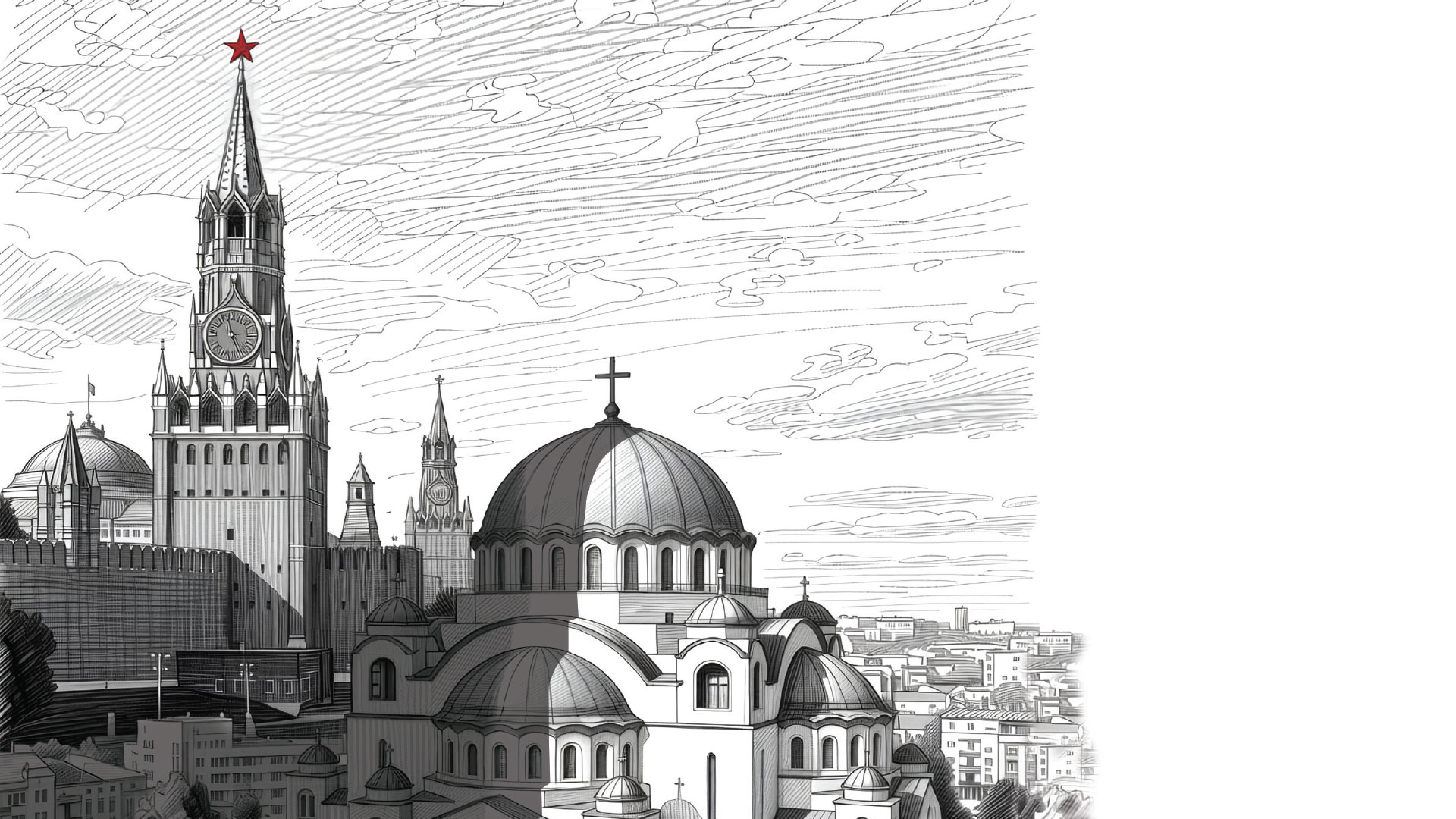
This paper examines how the Serbian Orthodox Church (SOC) is portrayed in existing research and media discourse, primarily as a major conduit of Russian influence in the Western Balkans through narratives tied to the Kremlin’s “Russian World” project and hybrid warfare activities.