PUBLICATION: Policy paper
More Than Moscow’s Shadow: Serbia’s Orthodox Church and Regional Influence
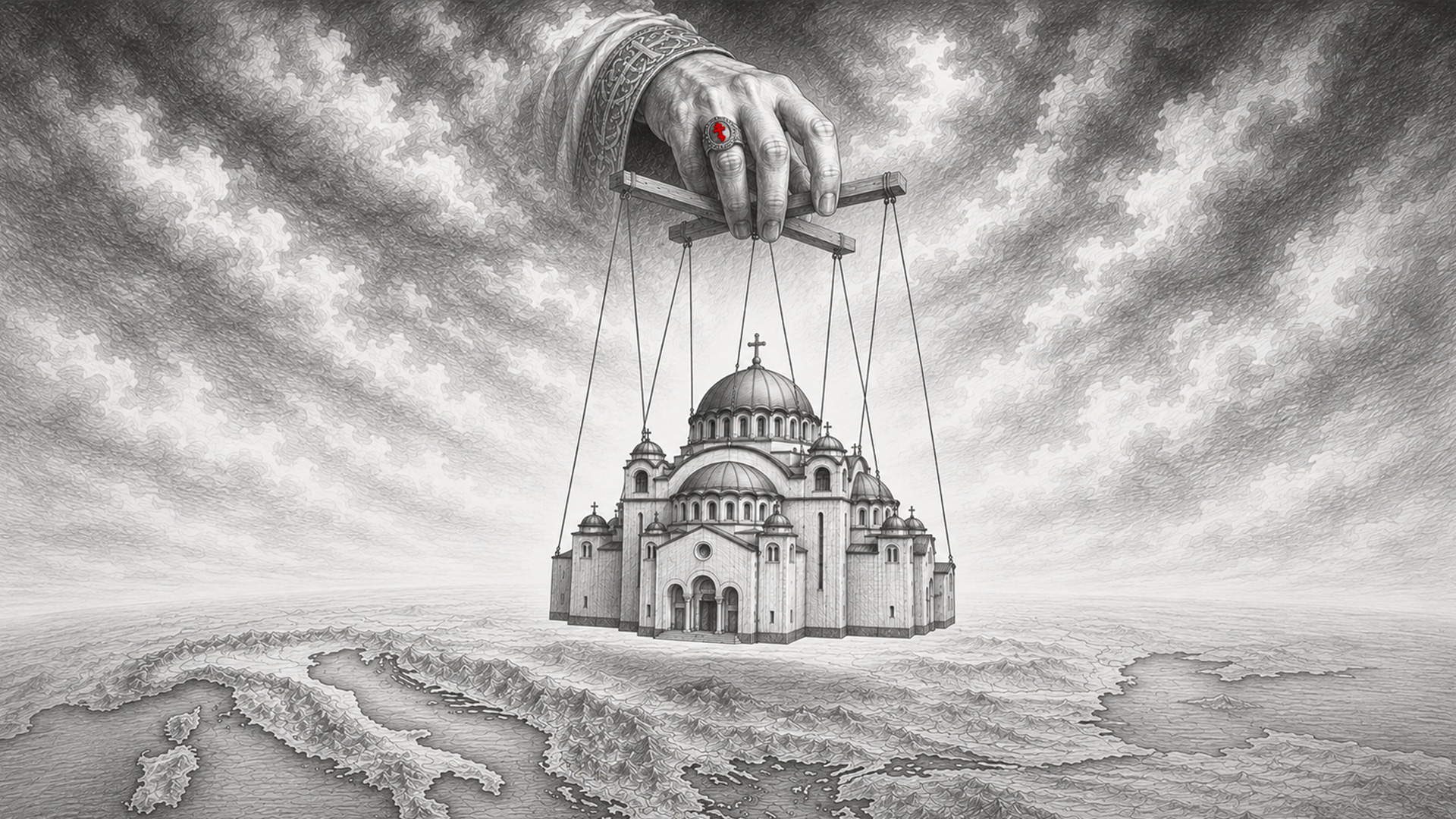
This paper examines how the Serbian Orthodox Church (SOC) is portrayed in existing research and media discourse, primarily as a major conduit of Russian influence in the Western Balkans through narratives tied to the Kremlin’s “Russian World” project and hybrid warfare activities.
These interpretations are based on the real and ongoing cooperation between the SOC and the Russian Orthodox Church (ROC), whose collaboration contributes to socio-political and security tensions in the region. However, while this publication does not dispute the significance of Russian influence, it highlights that such a focus has often overshadowed analysis of the SOC’s own expanding agency.
Recent academic and policy-oriented works increasingly acknowledge the SOC as not only a recipient of ROC influence, but also an autonomous religious-political actor embedded in local dynamics. This is particularly evident in the evolving concept of the “Serbian World”, that has been presented to the public by Serbia’s highest officials in 2021, where regional case studies and newer research demonstrates that the SOC actively shapes identity, discourse, and mobilisation across Montenegro, Bosnia and Herzegovina, and Serbia. In many cases these objectives overlap with those of Moscow, but, as recent research show, they are not entirely dictated by Kremlin.
Author: Richard Straka
Skip to PDF contentDETAILS
DATE: 07.04.2026
TOPICS: BSCP, Foreign Policy
TYPE: Policy paper
DOI Number: <a href="https://doi.org/10.55042/BAMB1125" target="blank">https://doi.org/10.55042/BAMB1125
AUTHORS
SHARE
PDF PREVIEW
RELATED
Date: 06.08.2026.
Author: Belgrade Centre for Security Policy
An analysis of cultural wars, anti-scientific narratives and student protests

Date: 21.07.2026.
Author: Dr Srđan Cvijić | Igor Bandović | Marko Drajić | Predrag Petrović |
In November 2025, the Belgrade Centre for Security Policy published the policy brief Political and Institutional Crisis in Serbia: Possible Scenarios. The brief outlined four scenarios and their corresponding outcomes.
New Extremist Trends in Serbia: Anti-System Extremism, Extremist Telegram Channels and Eco-Extremism
Date: 30.06.2026.
Author: Gorana Pebić | Isidora Stakić | Miloš Jovanović |
This report analyses recent and so far insufficiently explored forms of extremism in Serbia, with a particular focus on anti-system extremism, the role of the Telegram digital platform and the instrumentalisation of environmental issues.