PUBLICATION: Project
Visegrad support for dialogue between Serbia and Kosovo
The project is implemented by four think tanks, BCSP, CEPI from Bratislava, and D4D and KCSS from Prishtina, with the support from the International Visegrad Fund (IVF) founded by the governments of the Czech Republic, Hungary, the Republic of Poland, and the Slovak Republic.
Background
The EU-facilitated political dialogue between Belgrade and Prishtina has been the most successful mediation between the former adversaries in two decades. Its progress has important implications for EU enlargement and regional stability: tensions between Belgrade and Prishtina are holding the wider region hostage, and present the biggest challenge for regional cooperation and reconciliation in the Western Balkans. The EU has seized on the opportunity to push both sides to normalize relations, thus preventing another frozen conflict in Europe.
Who are we?
The project is implemented by four think tanks: Belgrade Centre for security Policy (BCSP), Central European Policy Institute (CEPI) from Bratislava, Democracy for Development (D4D) and Kosovar Centre for Security Studies (KCSS), both form Prishtina.
The project is funded by the International Visegrad Fund (IVF), an international organisation founded by the governments of the Visegrad Group (V4) countries – the Czech Republic, Hungary, the Republic of Poland, and the Slovak Republic. The purpose of the IVF is to facilitate and promote closer cooperation among citizens and institutions in the Central European region, as well as between the V4 region and other countries, especially the Balkan countries.
Project concept
Civil society in general and think-tanks in particular play an important role in fostering progress in post-conflict reconciliation. They help generate ideas on how to settle differences, provide a discreet platform for unofficial dialogue, and generate public support for compromises, thus countering the influence of extremists on both sides. Very little of such support, however, is now given to governments of Serbia and Kosovo. After a decade with almost no dialogue between their societies, Belgrade and Prishtina have to learn again how to talk to each other, on the official as well as other levels. The V4 countries can help in this process. They are regarded in the Western Balkans as a successful model of regional co-operation among the new EU members, and they enjoy a high reputation among decision-makers and the media both in Belgrade and Prishtina.
This project will allow participating think-tanks to create joint research network, hold a series of fact-finding missions and public events, examine ideas for collaboration between Serbia and Kosovo and sources of resistance on both sides. The aim of this project is to evolve into a permanent Visegrad platform for joint research between Serbian and Kosovar think tankers on reconciliation issues.
Main topics to be tackled
– Implementation of cross-border agreement and prevention of criminal activities across the disputed border;
– Rule of law and governance issues in Kosovo (including status of the North);
– The EU’s role, incentives (leverage) and perceptions in Belgrade and Prishtina.
Expected outputs
1. Policy memos with new ideas on compromise solutions for Serbia-Kosovo talks and for EU mediation (# 3 papers);
2. A policy brief on the best ways for the EU to foster Serbia-Kosovo reconciliation;
3. Series of public debates accompanied by public diplomacy & social networks strategy in Belgrade and Prishtina;
4. Series of parallel Serbia – Kosovo debates staged in each Visegrad capital to increase public awareness, stimulate media interest and engage the domestic expert community;
5. Capacity building seminars.
Tags: ..., bratislava, czech, dialogue, founded, governments, hungary, implemented, international, kosovo, poland, prishtina, project, republic, serbia, slovak, support, tanks, think, visegrad
DETAILS
AUTHORS

SHARE
PDF PREVIEW
RELATED

Date: 09.02.2026.
Author: Maja Bjeloš |
The concept of the “colour revolution” has shifted from describing democratic uprisings in post-socialist states to serving as a powerful tool of authoritarian control. In Serbia, the ruling elite—drawing heavily on the Russian strategic playbook—has reframed the term as a symbol of foreign subversion aimed at overthrowing the government and destabilising the country. Since 2012, this narrative has been systematically used to delegitimise dissent, protests, and civic mobilisation.
Date: 01.02.2026.
Author: Belgrade Centre for Security Policy
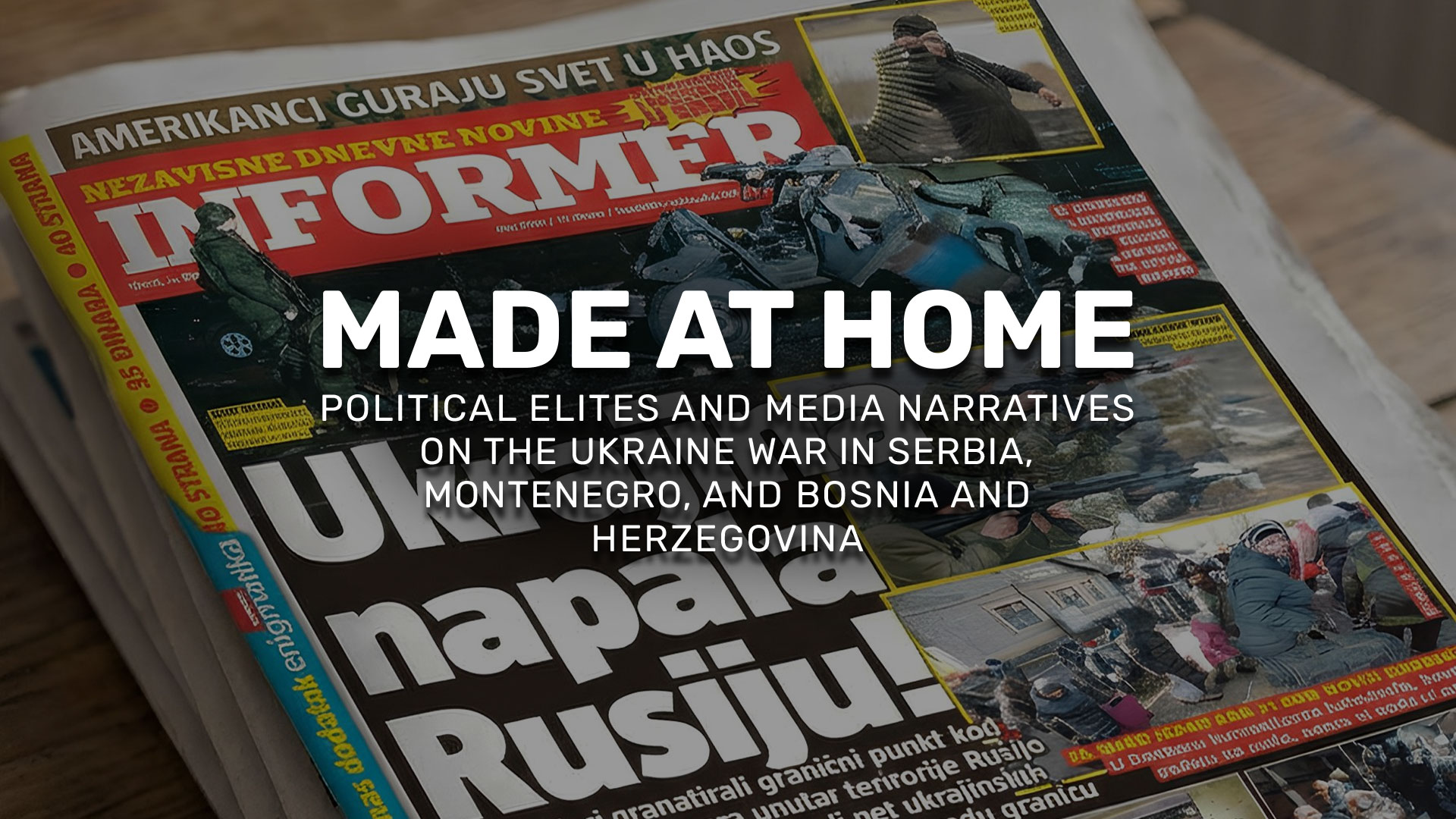
The war in Ukraine has reverberated across the Western Balkans in ways that reflect the region’s own political dynamics more than the influence of any external actor, including Russia. In Serbia, Montenegro, and Bosnia and Herzegovina, media coverage and public narratives surrounding the conflict have been shaped primarily by domestic political realities, local media structures, and long-standing identity divides.

Date: 22.10.2025.
Author: Jelena Pejić Nikić |
This policy paper examines Western Balkan stakeholders' perspectives on what is needed for meaningful enlargement and the EU reforms they consider essential for an effective expanded Union. Field research in spring and summer 2024 included 16 high-level interviews with representatives from all six countries of the region.