Context of SSR in the Western Balkans will be presented in Sarajevo on 22 March
The Belgrade Centre for Security Policy is pleased to invite you, on behalf of consortium of 7 regional think-tank organizations and the Geneva Centre for the Democratic Control of Armed Forces (DCAF), to attend the round table "Security Sector Reform in the Western Balkans: context and evolution from 1991 to 2010" in Sarajevo on 22 March 2011. The event will take place in the Parliamentary Assembly of Bosnia and Herzegovina in Sarajevo, between 10:00hrs and 12:30hrs.
This event will be the first public presentation of research findings 7 independent think-tank organizations have accomplished within 3-year project “Civil Society Capacity Building to Map and Monitor Security Sector Reform in the Western Balkans” which is financially supported by the Ministry of the Foreign Affairs of the Kingdom of Norway.
The project is aimed to contribute to the democratic governance of security sector in the Western Balkans by offering unique methodology for the assesment of the reform achivements in that field and by offering comparable research products produced by the independent think-tank organizations from the region.
Few could see security sector as an agent of change in the Western Balkans. These are hard-line, hierarchical structures. Yet, in a post-conflict, post-authoritarian setting, resources at their disposal could turn them into kingmakers; and in the case of at least one country, they did. Concerned with prospects for democratizing security governance in the Western Balkans, Belgrade Centre for Security Policy, along with six of its regional partners[1] and in cooperation with the DCAF is about to produce a “Context Analysis of the Security Sector Reform in Western Balkans” taking year 1991 as its point of departure. Authors began their research with the presumption how, in order to map and monitor the achievements and obstacles to security sector reform, it is of utmost importance to understand the socio-political context within which this reform has been carried out.
The roundtable will also allow a platform to compare and discuss major trends and challenges to SSR in different environments. Representatives of the 7 think-tank organizations from Albania, Bosnia and Herzegovina, Croatia, Kosovo, Macedonia, Montenegro and Serbia who have authored context analysis will have the opportunity to address different issues related to the context of SSR. Some of them are:
· What are the main trends in SSR in the past twenty years?
· What is the dominant context of SSR in each country / province today?
· What are the lessons to be learned from the past two decades? How relevant are they for current reforms?
· What is the public perception on threats and risks in each domain?
· What are the main challenges and obstacles to SSR in each domain?
· What are the actors which have been most influential in SSR?
Attached please find first of the papers made available, BCSP’s “Context Analysis of the Security Sector Reform in Serbia 1989-2010”.
Please confirm your attendance by contacting Jelena Radoman (BCSP) atjelenaradoman@ccmr-bg.org (+381) 11 32 87 334 and Sanja Mihajlovic (Centre for Security Studies, Sarajevo) at sanja@css.ba, 00 387 33 262 456.
[1] Institute for International Relations (Zagreb, Croatia), Centre for Security Studies (Sarajevo, Bosnia and Herzegovina), Centre for Democracy and Human Rights – CEDEM (Podgorica, Montenegro), Institute for Democracy and Mediation (Tirana, Albania), Analytica (Skopje, Macedonia) and Kosovo Centre for Security Studies (Prishtina, Kosovo).
DETAILS
DATE:
TIME:
LOCATION: Belgrade Center for Security Policy
CONTACT: dragana.belanovic@bezbednost.org
SHARE
RELATED
Date: 10.02.2026.
Author: Belgrade Centre for Security Policy
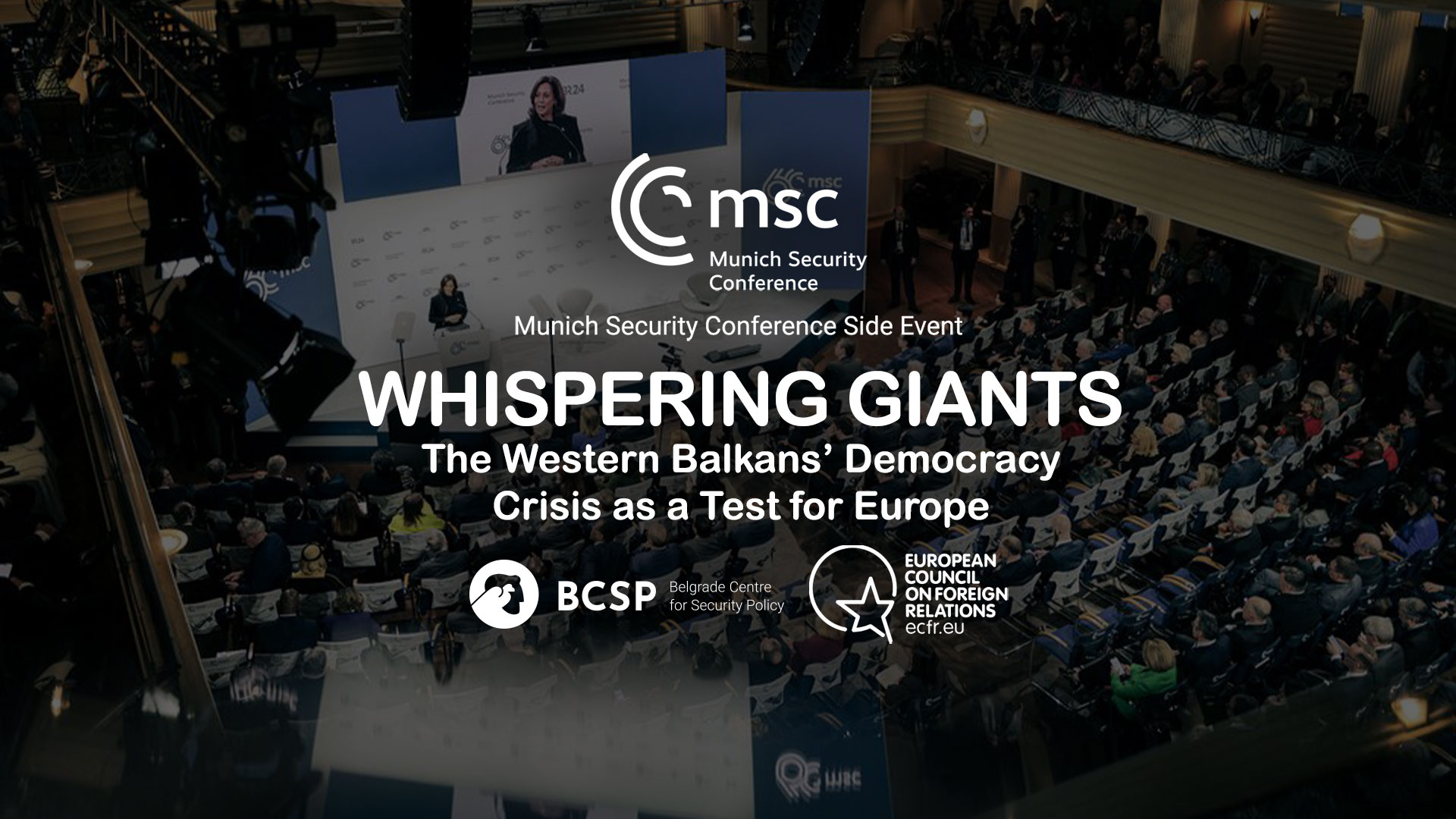
The Belgrade Centre for Security Policy (BCSP) and the European Council on Foreign Relations (ECFR) are co-hosting a side event "Whispering Giants: The Western Balkans’ Democracy Crisis as a Test for Europe," at this year’s Munich Security Conference on 13 February.

Date: 18.02.2025.
Author: Belgrade Centre for Security Policy
On 20 February 2025. at Envoy Conference, Belgrade Centre for Security Policy will present the latest research “Non-Malign Influence - What Does the Russian Community in Serbia Think and Do”.

Date: 10.02.2025.
Author: Belgrade Centre for Security Policy
The Belgrade Centre for Security Policy (BCSP) and the European Council on Foreign Relations (ECFR) are co-hosting a side event "Unarmed in the Unseen War: How to Counter Hybrid Challenges in the Western Balkans and Europe," at this year’s Munich Security Conference on 14 February.