Rule of Law or Law of the Unruly: a View from the Western Balkans
The biggest challenges to the rule of law in the Western Balkans will be the topic of panel discussions that will take place on March 9 at 10am in the library of the Belgrade Center for Security Policy (BCSP).
With the view to rekindling the debate on the most fundamental rule of law issues in the Western Balkans, BCSP invites you to a panel-discussion where the civil society representatives from the region will be discussing the following issues:
- the most concerning regional trends from the point of view of further democratisation
- the paradox of progress on the accession path and regress in measurable, practical terms
- the viable ways to fight corruption, reduce politicisation and promote the rule of law
- the need to shape up the EU’s approach to the Rule of Law chapters (Chapters 23 and 24)
- what are the useful lessons learned in the Croatia’s accession process
- if all else fails, how can civil society, media and the citizens contribute to bringing about the change
The topics mentioned above will be discussed by the following panellists:
- Saša Šegrt, GONG and Platform 112, Croatia
- Aleksandar Jovanoski, European Policy Institute, Macedonia
- Jovana Marović, Institute Alternativa, Montenegro
- Sonja Stojanović Gajić, Belgrade Centre for Security Policy, Serbia
Due to a limited number of available seats, please confirm your attendance by Tuesday, 8 March 2016, via email at office@bezbednost.orgor via phone at +381 11 3287 226.
The panel discussion is organised with support of the European Funds for the Balkans (EFB), within the framework of the Monitoring and Evaluating the Rule of Law in the Western Balkans project, implemented jointly by the European Policy Institute (EPI, Macedonia), Belgrade Centre for Security Policy (BCSP, Serbia) and Institute Alternativa (IA, Montenegro).The views expressed are the sole responsibility of the project implementing partners and can in no way be taken to reflect the views of the EFB or any of the affiliated institutions.
On the panellists:
Sasa Segrt is the Deputy Executive Director of GONG, in charge of coordinating project development. From 2008-2013 she was Executive Director of Transparency International Croatia, in which capacity she helped gathering informal coalition of civil society organizations for monitoring accession process in Chapter 23 (from which the Platform 112 derived) and preparing reports on accession to the EU. She also participated in working groups for analysis and monitoring of anticorruption legislation.
GONG is a civil society organization founded in 1997, with an objective of encouraging citizens for more active participation in political processes. GONG main mission is reinforcing and promoting basic human and civil rights, as well as empowering the citizens for more transparent and active participation in the process of political decision making. GONG also promotes the culture of dialogue, transparency, responsibility in the public sector, respect of human and civil rights, through research, proposals and education.
Jovana Marović has been working at Institute Alternative since 2010, first as a Senior Research Fellow and then as a Research Coordinator. Since March 2012 she has been a member of the Negotiating Group for Chapter 23 – Judiciary and Fundamental Rights – in the process of Montenegrin accession to the EU. Her professional interests are fight against corruption, public administration reform, EU democratic deficit and more.
IAfunctions as a think tank, a research centre, focusing on the overarching areas of good governance, transparency and accountability. Based on four main programs (public administration, accountable public finance,security and defence, parliamentary program), IA monitors the process of accession negotiations with the EU, actively participates in working groups 23 (Judiciary and Fundamental Rights) and 32 (Financial Control). IA also has a representative in the Governments’ Operation team for the global Open Government Partnership initiative. IA received the official certificate from the Ministry of Science to conduct research in the field of social science in 2013.
Aleksandar Jovanoskiis EPI’s Programme Coordinator for Democracy and Rule of Law. He holds an MA in European Integration and Development, with specialization in European political integration and area of justice, freedom and security. Aleksandar’s research interests are focused on accession process of Macedonia especially in the Democracy and Rule of Law Area and evaluation of the policies under Chapter 23 – Judiciary and fundamental rights.
EPI, through research and proposals, provides a sound basis for debate on European policy aimed at facilitating solutions by policy creators, involving the public. EPI regularly monitors the EU accession process of Macedonia within the regional contexts, evaluates the creation and implementation of EU-related policies and actively advocates for policy options. One of its objectives is raising public awareness of decision-makers on the EU integration policy, as well as promoting critical thought, research and analysis in creating and implementing strategies and policies of EU integration.
Sonja Stojanovic Gajićis the BCSP director. She holds an MA in Politics, Security and Integration from the University College London. She is involved in the work of civil society coalition prEUgovor, tasked with monitoring progress in Chapters 23 and 24; coordinator of the Working Group for Chapter 24, National Convention on the EU; and a Serbian representative for the Rule of Law area in the Joint Consultative Committee under the European Economic and Social Committee.
BCSPis an independent research centre dedicated to advancing security of the citizens and society they live in on the basis of democratic principles and respect for human rights. In the midst of the Centre's interest are all policies aimed at the improvement of human, national, regional, European, and global security.BCSP conducts research and problematizes the need for Serbia’s involvement in the processes of regional security cooperation and integration.
DETAILS
DATE: 20160309
TIME: 10:00:00
LOCATION: Beogradski centar za bezbednosnu politiku
CONTACT: dragana.belanovic@bezbednost.org
SHARE
RELATED
Date: 10.02.2026.
Author: Belgrade Centre for Security Policy
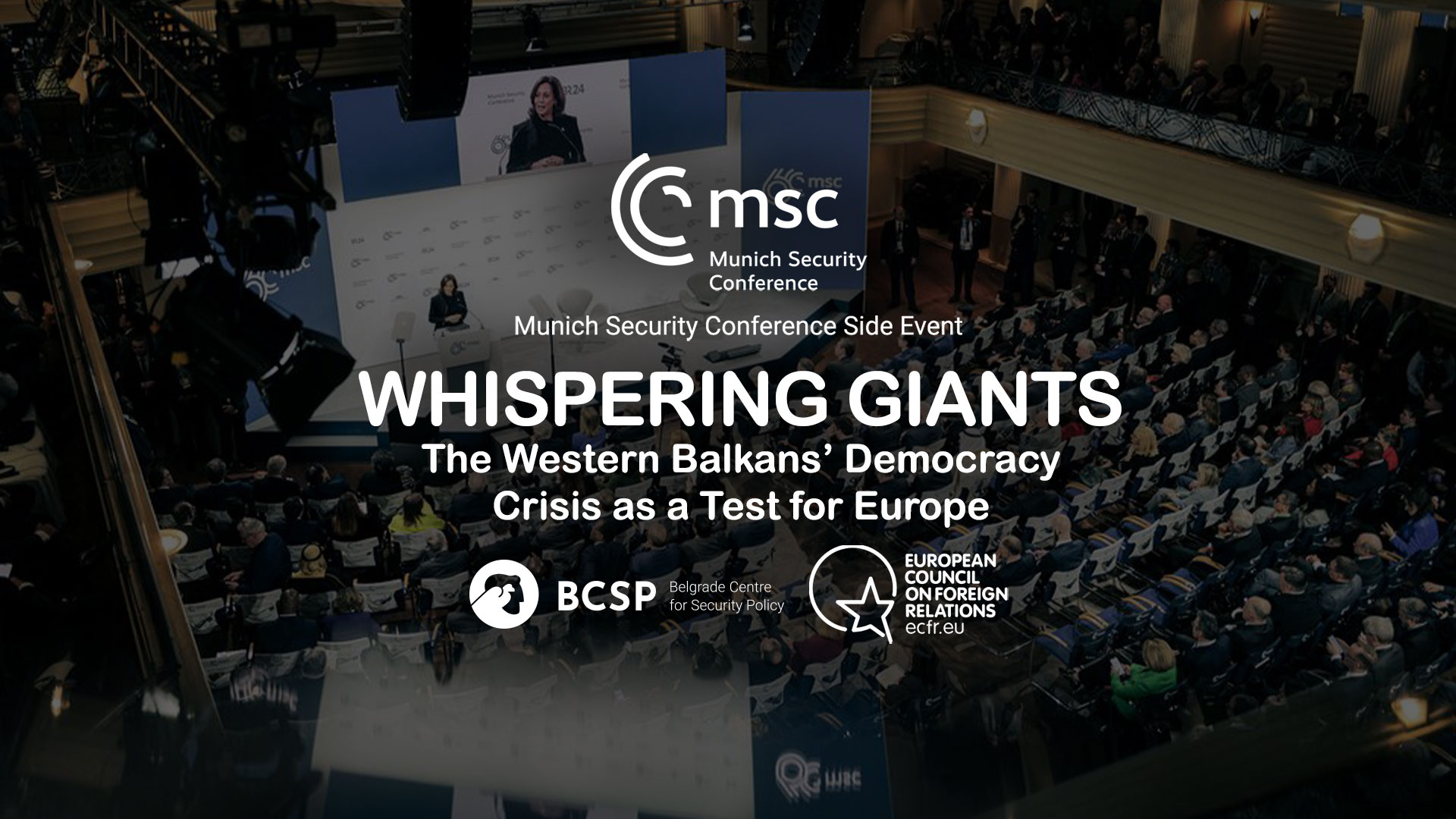
The Belgrade Centre for Security Policy (BCSP) and the European Council on Foreign Relations (ECFR) are co-hosting a side event "Whispering Giants: The Western Balkans’ Democracy Crisis as a Test for Europe," at this year’s Munich Security Conference on 13 February.

Date: 18.02.2025.
Author: Belgrade Centre for Security Policy
On 20 February 2025. at Envoy Conference, Belgrade Centre for Security Policy will present the latest research “Non-Malign Influence - What Does the Russian Community in Serbia Think and Do”.

Date: 10.02.2025.
Author: Belgrade Centre for Security Policy
The Belgrade Centre for Security Policy (BCSP) and the European Council on Foreign Relations (ECFR) are co-hosting a side event "Unarmed in the Unseen War: How to Counter Hybrid Challenges in the Western Balkans and Europe," at this year’s Munich Security Conference on 14 February.