PUBLICATION: Analysis
The Citizens on the Serbian-Albanian Relations and the Regional Security Cooperation
Belgrade Centre for Security Policy (BCSP) in cooperation with Kosovar Centre for Security Studies (KCSS) and Institute for Democracy and Mediation (IDM) presents the latest public opinion research findings on the Brussels dialogue, the future of relations within the Belgrade-Pristina-Tirana triangle, and human security in each community.
The majority of citizens in Serbia and Albania support the continuation of the Brussels dialogue between Belgrade and Pristina even if it is not a condition for EU membership, while the most of population of Kosovo and Metohija favors the Dialogue only if it is conditioned by the European Union, shows a survey conducted within the project Security Research Forum Belgrade-Pristina-Tirana.
The survey was based on the same questionnaire and conducted in Serbia, Kosovo and Albania during the first three weeks of October 2013.
The survey covered representative samples of citizens. In Serbia, a number of 1200 citizens was interviewed, including a sub-sample of 200 citizens in Southern Serbia (the municipalities of Preshevo, Bujanovac and Medvedja). The survey in Kosovo encompassed 1119 respondents including 100 ethnic Serbs residing in Northern Kosovo. In Albania, 1100 citizens were interviewed.
DETAILS
AUTHORS

SHARE
PDF PREVIEW
RELATED

Date: 21.07.2026.
Author: Dr Srđan Cvijić | Igor Bandović | Marko Drajić | Predrag Petrović |
In November 2025, the Belgrade Centre for Security Policy published the policy brief Political and Institutional Crisis in Serbia: Possible Scenarios. The brief outlined four scenarios and their corresponding outcomes.
Date: 28.05.2026.
Author: Belgrade Centre for Security Policy
As the coordinator of the Working Group for Chapter 24 within the National Convention on the European Union (NCEU), BCSP compiled joint comments from nine NCEU member organizations on the Draft Law on Internal Affairs, which was subject to official public debate in April 2026.
Date: 07.04.2026.
Author: Belgrade Centre for Security Policy
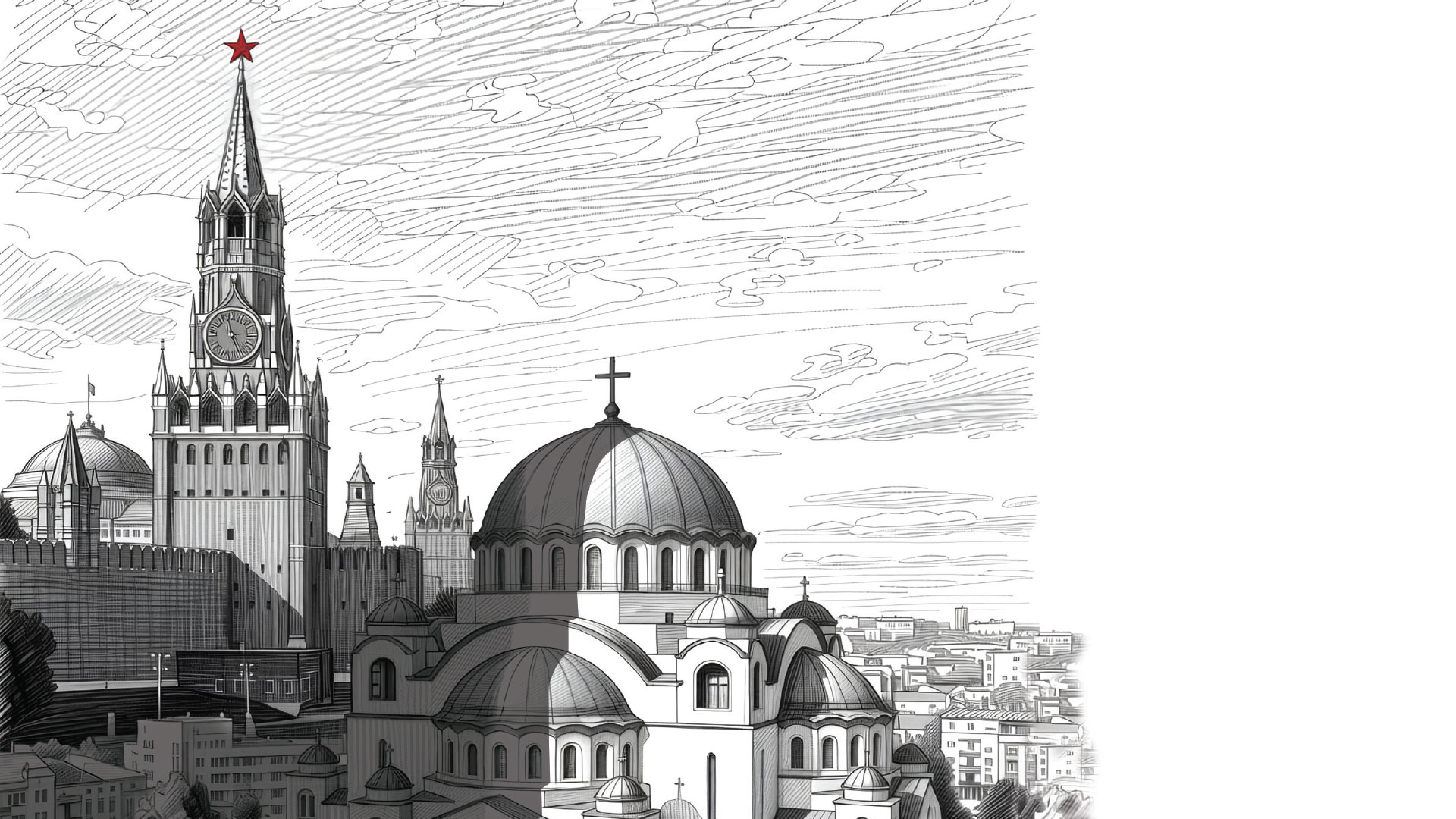
This paper examines how the Serbian Orthodox Church (SOC) is portrayed in existing research and media discourse, primarily as a major conduit of Russian influence in the Western Balkans through narratives tied to the Kremlin’s “Russian World” project and hybrid warfare activities.